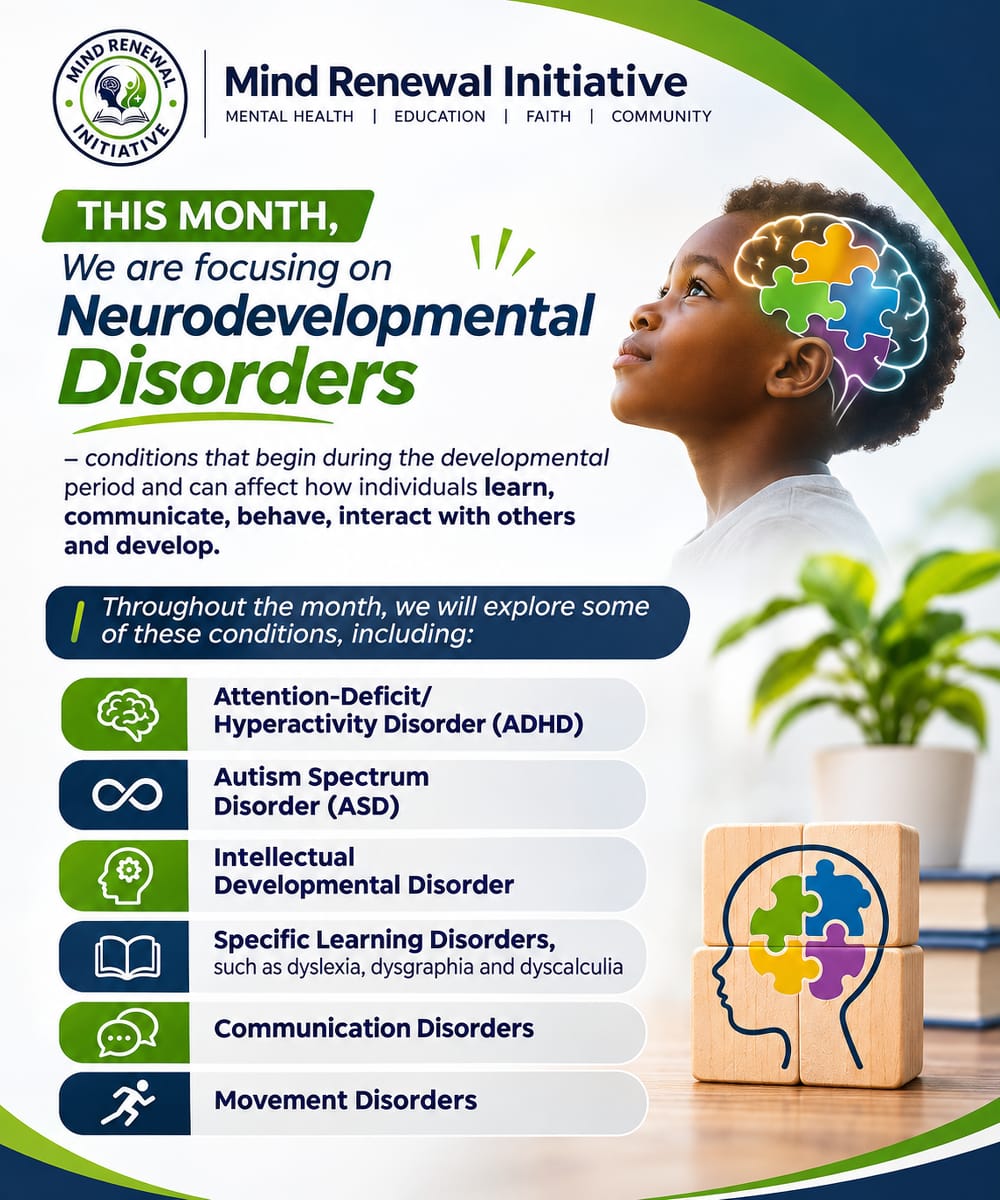
This month, we are focusing on Neurodevelopmental Disorders
Understanding Neurodevelopmental Disorders: Recognising Differences in How We Learn, Communicate and Develop
Every individual develops differently. From the way we learn and communicate to how we behave, interact with others and navigate the world around us, our brains play a central role in shaping these experiences.
However, for some individuals, differences in brain development can affect these processes in ways that may make certain aspects of everyday life more challenging. These differences may be associated with Neurodevelopmental Disorders.
Neurodevelopmental disorders are a group of conditions that begin during the developmental period, usually in childhood. They can affect various aspects of development, including learning, attention, communication, behaviour, movement, intellectual functioning and social interaction.
It is important to understand that these conditions do not look the same in everyone. Individuals may experience different symptoms, strengths and challenges, even when they have the same diagnosis.
What Will We Be Exploring This Month?
Throughout this month, Mind Renewal Initiative will be focusing on neurodevelopmental disorders, creating awareness and promoting a better understanding of the conditions, how they present and how they affect individuals and families.
Some of the conditions we will be exploring include:
- Attention-Deficit/Hyperactivity Disorder (ADHD): A condition characterised by persistent patterns of inattention and/or hyperactivity and impulsivity that can affect daily functioning.
- Autism Spectrum Disorder (ASD): A neurodevelopmental condition associated with differences in social communication and interaction, alongside restricted or repetitive patterns of behaviour, interests or activities.
- Intellectual Developmental Disorder: A condition involving significant limitations in intellectual functioning and adaptive behaviour, affecting how an individual learns and manages everyday activities.
- Specific Learning Disorders: Conditions that affect the acquisition and use of particular academic skills, including reading (dyslexia), written expression (dysgraphia) and mathematics (dyscalculia).
- Communication Disorders: Conditions that affect speech, language and communication skills, making it difficult for individuals to express themselves or understand others.
- Movement Disorders: Conditions that affect motor development and coordination, including difficulties with movement, balance and the control of motor activities.
Why Does This Conversation Matter?
Unfortunately, many neurodevelopmental conditions are misunderstood. Children and adults who experience these differences may be labelled as lazy, stubborn, unserious, disobedient or unintelligent simply because others do not understand their challenges.
A child who struggles to read a simple sentence may not be unwilling to learn. A child who finds social interactions difficult may not necessarily be rude or unfriendly. An individual who struggles with attention may not simply be careless.
Sometimes, what we interpret as a behavioural problem may be a reflection of an underlying developmental difference.
Understanding is the first step towards acceptance, early identification, appropriate support and inclusion.
As we explore these conditions throughout the month, our goal is to make these conversations easier to understand, challenge misconceptions and encourage more supportive environments for individuals living with neurodevelopmental disorders.
Because every individual deserves the opportunity to learn, grow, participate and thrive.
Join us throughout this month as we learn, unlearn and build a more informed and inclusive society.